
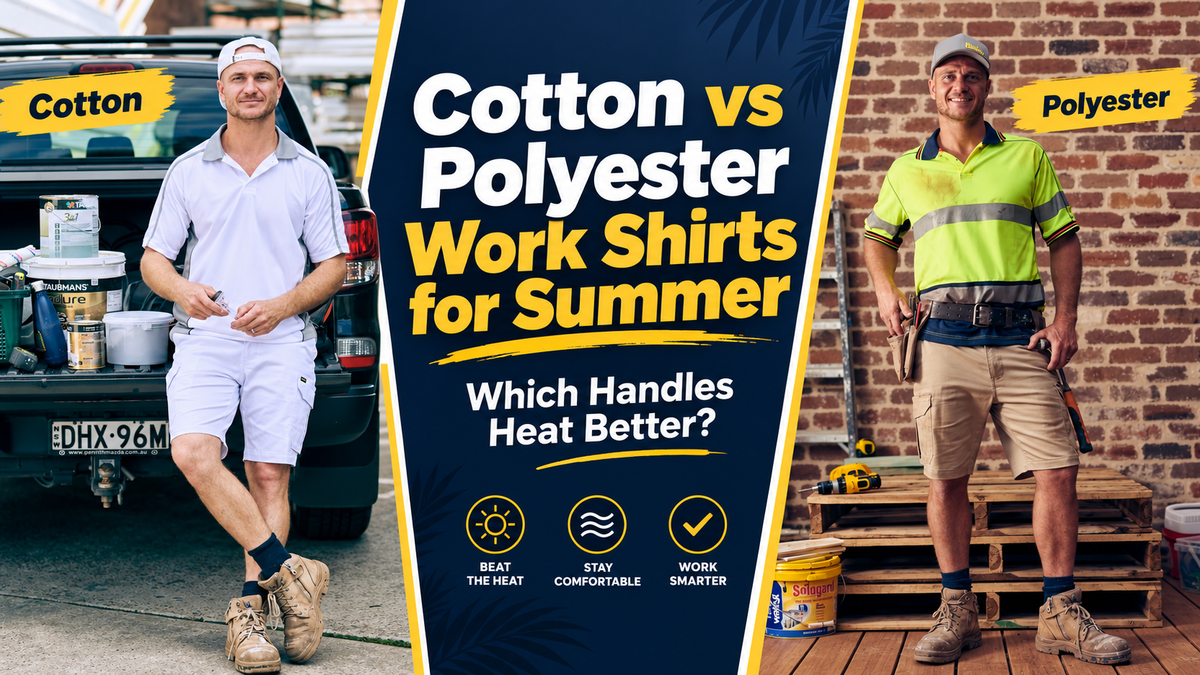
When an Australian summer shift starts heating up, the fabric in your work shirt can make a bigger difference than you might think.
Cotton has long been a favourite on Australian worksites. Polyester, meanwhile, appears in many modern lightweight and moisture-wicking work shirts designed for hot, active conditions.
So which one actually handles summer better?
The short answer is that neither fabric wins every time.
Cotton can feel light and breathable against the skin, while polyester-based performance fabrics can move moisture and dry faster. Fabric weight, ventilation, fit and how the shirt has been constructed can matter just as much as whether the label says cotton or polyester.
Here is what Aussie tradies should know before choosing their next summer work shirt.
Cotton vs Polyester Work Shirts: The Quick Comparison
| Feature | Cotton Work Shirt | Polyester or Polyester-Blend Work Shirt |
|---|---|---|
| Feel against the skin | Soft, natural feel | Depends on fabric construction and blend |
| Moisture | Absorbs sweat into the fibres | Performance fabrics may move moisture away from the body |
| Drying | Can remain damp longer once saturated | Generally dries faster |
| Airflow | Can perform well when lightweight and vented | Depends heavily on weave, mesh and garment design |
| Hot active work | Good when lightweight and ventilated | Useful when moisture management and quick drying are priorities |
| Best choice | Depends on the job and conditions | Depends on the job and conditions |
Why Cotton Work Shirts Are Still Popular in Australian Summer
There is a reason cotton work shirts have been worn by Australian tradies for decades.
Cotton is a natural fibre that absorbs moisture and can feel pleasant against the skin, particularly when the fabric is lightweight and the shirt allows enough airflow.
But not every cotton work shirt performs the same way in summer.
Fabric weight matters
A heavy cotton drill shirt can feel completely different from a lightweight cotton shirt once the temperature climbs.
For summer, it is worth checking the GSM rather than simply choosing a shirt because it is made from cotton.
The Bisley Cool Lightweight Drill Shirt BS1893, for example, uses 155gsm preshrunk cotton drill along with 125gsm cotton open mesh ventilation through the back and underarms.
That combination shows why fabric composition alone does not tell the whole story. It is still a 100% cotton work shirt, but the lighter drill and strategically placed mesh make it very different from a heavier traditional cotton drill shirt.
Cotton absorbs sweat
One of cotton's biggest characteristics is also something tradies should think about in hot weather.
Cotton absorbs moisture into the fabric.
During a mild shift, that may not be a major problem. But if you are sweating heavily for several hours, the shirt can become increasingly wet and may take longer to dry.
If you have ever finished a summer shift with a cotton shirt that feels noticeably heavier than it did at 7am, this is likely part of the reason.
What Makes Polyester Different in Hot Weather?
Polyester behaves differently from cotton.
Rather than absorbing large amounts of moisture into the fibre itself, polyester is commonly used in fabrics designed to move sweat across the material so it can evaporate more readily.
This is why polyester and polyester blends frequently appear in sportswear, activewear and modern performance workwear.
Polyester can dry faster
For tradies who sweat heavily or move constantly during a shift, faster-drying fabric can be useful.
A shirt that manages moisture effectively may spend less time feeling heavily saturated against the body.
However, there is an important catch.
Simply seeing the word "polyester" on a product label does not automatically mean the shirt is suitable for Australian summer.
A poorly ventilated, heavy polyester shirt can still feel hot.
You need to look at the entire garment.
Modern Work Shirts Often Use a Blend for a Reason
The choice is not always 100% cotton versus 100% polyester.
Many modern work shirts combine different fibres to achieve particular characteristics.
The Bisley X Airflow Stretch Ripstop Shirt BS6490 is a good example.
It uses:
- 88% polyester
- 9% cotton
- 3% spandex
- 140gsm stretch ripstop fabric
- Permanent wicking
- Bisley X Airflow ventilation through multiple heat-stress areas
Rather than relying on fibre alone, this shirt combines lightweight fabric, stretch, moisture management and ventilation.
That is the type of specification worth comparing when buying work shirts for Australian summer.
So, Is Cotton Cooler Than Polyester?
Not automatically.
This is where simple fabric comparisons can become misleading.
A lightweight 155gsm cotton shirt with mesh ventilation could suit hot conditions far better than a heavy polyester shirt with little airflow.
At the same time, a lightweight polyester-blend shirt with moisture-wicking fabric and targeted ventilation may handle a high-sweat shift better than a cotton shirt that becomes heavily saturated.
The question should not simply be:
"Is cotton or polyester cooler?"
A better question is:
"How has this particular shirt been designed to handle heat, sweat and movement?"
When Cotton May Be the Better Summer Choice
A lightweight cotton work shirt can make sense when:
- You prefer a natural-fibre feel
- Your work shirt includes back or underarm ventilation
- You are not constantly soaking through your shirt
- You work in hot but relatively dry conditions
- You prefer traditional cotton drill workwear
- The garment meets your site's requirements
For many Aussie tradies, lightweight cotton drill remains a solid summer option, particularly when ventilation is built into the shirt.
WorkStitch carries several lightweight Bisley cotton shirts, including the Bisley X Airflow Ripstop Shirt BS6414, which uses 150gsm cotton ripstop with 125gsm cotton open mesh.
When Polyester or a Polyester Blend May Make More Sense
A polyester-based work shirt may be worth considering when:
- You sweat heavily during physical work
- You want fabric designed to wick moisture
- You need your shirt to dry quickly
- Your role involves constant movement
- You prefer stretch in your work shirt
- The garment uses lightweight fabric and targeted ventilation
The key is looking for performance features rather than assuming every polyester shirt will behave the same way.
What About Smell After a Hot Shift?
This is another practical difference worth considering.
Any work shirt can smell after a long, sweaty day, especially if it stays damp in a ute, locker or washing basket.
The best approach is simple.
- Do not leave sweaty shirts bundled up overnight
- Follow the garment's washing instructions
- Allow shirts to dry completely before wearing or storing them
- Rotate several shirts through the working week
- Wash heavily sweated workwear promptly
Whatever fabric you choose, good garment care becomes even more important during Australian summer.
Do Not Forget About Ventilation
If there is one thing to take away from the cotton versus polyester debate, it is this:
Fabric fibre is only part of the story.
Ventilation can completely change how a work shirt performs on a hot day.
Look for features such as:
- Mesh back panels
- Underarm ventilation
- Perforated side panels
- Lightweight fabric
- Room through the shoulders and upper back
- Moisture-wicking fabric where appropriate
Bisley's X Airflow range is specifically designed around ventilation at areas where heat tends to build, making it worth considering when shopping for summer work shirts.
What About Hi-Vis Work Shirts?
If your workplace requires hi-vis clothing, fabric preference comes after workplace requirements.
Fortunately, lightweight summer hi-vis shirts are available in different fabric constructions.
The Bisley Taped Hi Vis Cool Lightweight Shirt BS6896, for example, uses 155gsm preshrunk cotton drill with underarm and back cooling vents.
When comparing hi-vis work shirts, check the fabric weight, ventilation, sleeve length, visibility requirements and whether reflective tape is required for your particular workplace.
Cotton vs Polyester: Which Should Aussie Tradies Buy?
If you prefer a natural fibre and want a traditional work shirt for hot conditions, lightweight ventilated cotton is hard to overlook.
If you sweat heavily and want faster-drying, moisture-wicking fabric, a lightweight polyester blend may be a better fit.
But do not make the decision based on fibre alone.
Before buying your next summer work shirt, compare these five things:
- Fabric composition
- GSM
- Ventilation
- Moisture management
- Workplace requirements
A well-designed 140gsm polyester blend and a vented 150 to 155gsm cotton shirt can both be strong summer choices. They simply handle heat and sweat differently.
Find the Right Summer Work Shirt at WorkStitch
There is no need to spend another Australian summer rotating through shirts that feel wrong by lunchtime.
WorkStitch stocks Bisley work shirts across lightweight cotton drill, cotton ripstop, polyester blends, stretch fabrics, hi-vis and X Airflow designs.
Compare the fabric, check the GSM and look closely at where the ventilation sits before choosing your next shirt.
Shop Bisley work shirts at WorkStitch and find a summer-ready option that suits the way you actually work.


